Monday, July 28, 2014
Splendid Hermitage Museum in St. Petersburg
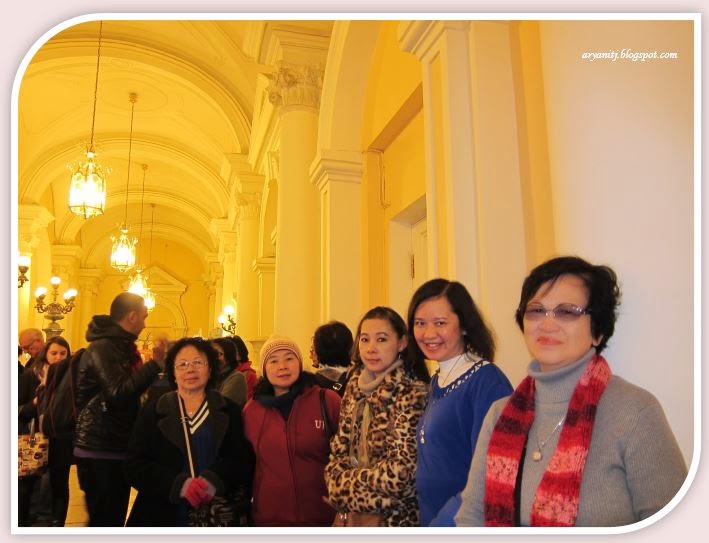
The guide distributed the entrance ticket, we had to wait for the completeness of the group member, as the museum is so huge, the tour leader was afraid of losing the member as the time was very tight, only 3 hours for exploring it. The museum build with Baroque architecture style with green-and-white three-storey building. Entering the aisle we welcome by some souvenir stores, we had to take off our coat and leave it in the deposit counter. Some tour members were attempted to shop, but our guide prohibited and suggested to do it after exploring the museum. The elegantly aisle with the white arches and pillars were very beautiful decorated with yellow light. Some huge marble statues were decorated at the side of the aisle, we're not allowed to touch them.
Guidance by the local guide, we explored the ground floor which was designed by German architect Leo von Klenze using painted polished stucco, while the columns made of natural marble and granite. The first room we visited was the Egyptian hall in the eastern part of the Winter Palace, contained of classical modest antiquities collection. The most interesting one was the mummy including its coffin which was formed as a human and carved beautifully to save the dead body. Inside the coffin was carved Anubis, an incredibly ancient God, as the original God of the dead.
After going through red aisle, full of carved stone as the wall decoration on the left and right side, we arrived in a hall made of marble from floor, wall, up to the ceiling. No plain surface, all of them were carved and painted elegantly with soft colour, although no air conditioner it's cold because of the natural marble. We entered The Cabinet of Sculpture room which were full of white sculpture with Roman mosaic floor from the late 3rd century A.D. We passed through a small hall with an immense "Tsarina of Vases", weighing 19.2 tonnes, made of grey marble. It is a symbol of the extremely high professionalism of the stone-cutters of the Altai to work on the single five-metre block of Revnev jasper.
Continue to The Hall of Graeco-Etruscan Vases, a room with two rows of pillars made of gray granites. Some ancient vases kept in this hall provide a picture of the different centres of ceramic production in Greece and Italy. The wall and the ceiling were covered with painting inspired by the decoration of ancient pottery. Acanthus ornament and a meander pattern were embellished museum's mosaic floor. I didn't hear the local guide explanation, but busy to take some photos.
From ground floor we went up to the first floor via stairs on the red carpet, no escalator or lift here :-) Some senior people had difficulty to go up, they had to walk slowly climbing the stairs. A huge green Malachite Medici-shape vase enhanced by the gilded bronze elements - massive handles in the form of snake tails and hoops was put right beside of the end of the stairs. The Russian craftsmen who worked with malachite produced their pieces using "Russian mosaic" technique. They cut the malachite into thin slices and stuck them onto a base following the natural grain of the mineral so as to create the impression of a single piece of stone.
We also visited a room displaying Armour Set for Horse and Rider. Some armour clothes style including the helmet from 15th-17th centuries were displayed inside a glass cupboard. You could imagine how heavy the clothes, and how strong the army's physic during the ancient war, unfortunately we could not touch it unless it would ruin because of the age. We also explored porcelain collection, some of them were kept in a pyramid glasses with made of glass with golden frame.
Entered the central room of the New Hermitage called Italian School room, which was full of paintings and malachite creation. The room was guided by some persons to remind and warn the visitors not to touch the painting or sat on the furniture. The immense size, the striking ceiling decoration, the combination of rich red walls and the gleam of gilded frames and furniture, magnificent vases and lighting devices made of coloured stone together create an impression of truly palatial luxury. The display covers a period from the twilight of the great age of the Renaissance to the time when Rome became the school for the entire artistic world. Presented here are large-format works by artists of the Venetian, Roman, Bolognese and Florentine schools from the 16th and 17th centuries.
The most area I like was The Raphael Loggias as a copy of the famous Gallery created in the 16th century in the Vatican Palace by the architect Donato Bramante. Its walls and vaults were painted by Raphael's pupils with Bible stories. The decoration of the gallery embodies a typical Renaissance tendency to reveal connection between Classical Antiquity and Christianity. It's very colorful and beautiful pictures surrounding with golden frame. Unfortunately we didn't have enough time to see the painting one by one, also a guide was definitely needed to tell the story. Anyway the full painting on the wall and arches created a beautiful picture on the photo.
Last room visited was the Pavilion Hall, to admire James Cox’s Peacock Clock. The Golden Peacock Clock was a present from Grigori Alexandrovich Potemkin to Catherine the Great. It is the only large 18th-century automaton in the world to still be functioning in its original unaltered condition. The room was full of visitors from various group tours who would like to see the peacock closer around the big glass cupboard, it's really hard to get a full picture of the peacock, as the glass was full of golden frame.
The luxurious main staircase of the Winter Palace, known as the Ambassadors' Staircase or Jordan Staircase (a celebration of Christ's baptism in the Jordan River), was led us to end of the journey. Two broad flights of marble steps lead up to a landing embellished with grey granite columns. The 18th-century ceiling painting by Gasparo Diziani depicting Mount Olympus visually enlarges the interior that is transfused with light, gleaming gold and mirrors. The staircase (retaining the original 18th-century style) was adorned with statues, some of which were brought from Italy in Peter the Great's reign. It's very magnificent, imagine you could see the guest who would go for dancing ballroom through this staircase. It's really like the palace that we could imagine the grandeur and the beauty.
One could spend days in the labyrinthine rooms and anterooms and never see all the art on display, we had to rush, some rooms were skipped, anyway we had seen many great exhibits. The palace building was awesome, the collection was plentiful and the history was fascinating. It's a must visit when you travel to St. Petersburg. If you don't join a group tour, it would be better to rent an audio tour, so you'll understand what you see and enjoy the exhibits. Read More ..
Thursday, August 29, 2013
Grandeur and Majestic Peterhof at St Petersburg
After lunch we relaxed outside the restaurant. The weather was very nice, fresh, cool with the shiny sun and very clear blue sky. We liked to sit on the bench in front of the restaurant while waiting for our friends to wait their turn using the restroom as it's only available one for woman and one for man.
Just walking distance we could see the palace, unfortunately the palace & museum were under renovation so we could not enter it. St. Peterhof, built in the 18th century by Peter the Great was one of UNESCO World Heritage Site. Lucky that the dome was not covered with the renovation activity, so we still could take beautiful picture of the palace. Anyway we still could enter its huge beautiful park.
The lower garden called Nizhny Sad, at 1.02 km² comprising the better part of Peterhof's land area, are confined between the 16 metres height cliff and the shore, stretching east and west for roughly 200 metres. We could see the lavish of Russian emperor's lifestyle, also understand the monarch's wealth and taste for luxury. The park was full of beautiful golden statues with many fountains and green grass. Fortunately we visited on the spring, when the famous fountains are in operation (May to early October).
The main attraction were the Grand Cascade and Samson Fountain, it was very elegant and artistic. The Grand Cascade is modelled on one constructed for Louis XIV at his Château de Marly, which is likewise memorialised in one of the park's outbuildings. The most famous ensemble of fountains, the Grand Cascade, which runs from the northern facade of the Grand Palace to the Marine Canal, comprises 64 different fountains, and over 200 bronze statues, bas-reliefs, and other decorations.
The fountains of the Grand Cascade are located below the grotto and on either side of it. Their waters flow into a semicircular pool, the terminus of the fountain-lined Sea Channel. In the 1730s, the large Samson Fountain was placed in this pool. It depicts the moment when Samson tears open the jaws of a lion, representing Russia's victory over Sweden in the Great Northern War, and is doubly symbolic created by Mikhail Kozlovsky. When taking picture near the fountain, we had to be careful as the water splash could wet the camera's lens.
As we didn't have enough time to buy souvenirs, we stopped by in a small stall in the areas as my sister and mom were interested to its stuffs. We didn't have any Rubel, lucky that the friendly woman seller would like to accept Euro, so we could start bargaining to get the competitive price :-)
After getting the souvenirs, we walked to the shore, as we didn't have enough time to explore it, we just stopped in the middle of the way, taking pictures on the bridge where we could see the shore and the palace on the opposite site. As time ticking we returned to the cliff, anyway we still stop by to take picture on the small forest, unfortunately no much leaf at that time as spring just started, some benches were available for guests to enjoy the environment and taking a rest.
The same cliff that provides a setting for the Grand Cascade houses two other, very different cascades. West of the Grand Palace is the Golden Mountain, decorated with marble statuary that contrasts with the riotous gilded figures of the Grand Cascade. To the east is the Chess Mountain, a broad chute whose surface is tiled black and white like a chessboard. The most prominently positioned fountains of Peterhof are 'Adam' and 'Eve' which occupied symmetric positions on either side of the Sea Channel, each at the conjunction of eight paths.
The beauty of the gardens, the charm of the fountains, and the luxury of the palaces all make for a memorable experience. Actually we need more time to explore the whole area as we haven't visited the museum, the shore and the upper garden. Read More ..
Friday, May 31, 2013
Amazing Moscow Metro Station
During our visit to Moscow, the tour brought us to explore Moscow Metro station. There were 30 of us including the local guide and tour leader. They kept saying that we had to be careful with our stuffs (be careful with pickpockets) and we must be together in one group. The train door only opened a very short time, so we had to hurry to enter the train. Waiting for the local guide bought the tickets, it's decorated by some golden colour carving on the pillar. One ticket could be used by all of us, but we had to wait for our turn one by one passing the electronic gate.
We headed directly to the very long escalator to go downstairs. Standing must be on the right side, unless the hasty people would hit you. Entered "Prospekt Mira" Metro Station, we're stunned by different decoration style from the common metro station. The overall station was made from light coloured marble. Some marble benches attached to the wall available for people to wait for the train. The pillar decorated with flared white marble, ceramic bas-relief frieze (sculptor G.Motovilov) made of floral elements and a golden medallion at the center described agriculture development added the beauty of the environment. The chessboard floor pattern's made of grey and black granite. The ceiling vault is decorated with casts, and lighting comes from several cylindrical chandeliers.
The track walls decorated with dark red marble, a golden iron sculpture on the track wall displayed "1951" when the station was built. The local guide gave us chance to take pictures and enjoyed the environment by letting some trains passed by. The station was quite crowded, so we had to be patient to get the good shoot. After satisfied with pictures, we took the next train, it was quite clean inside, unfortunately we could not read the metro map as it's in Russian language.
We stopped at the next station called "Komsomolskaya". It looked more luxurious, dominated with yellow colour painting on the ceiling. Komsomolskaya was the apogee of Stalin’s Empire style of Moscow underground, designed as entrance of the visitors to give the best first impression of the capital. Designed by Dmitry Chechulin the platform had 68 pillars pinkish limestone and blue-grey marble, while the floor was tiled with grey granite. No sculpture on the pillar, but the imposing Baroque celling, was decorated with eight mosaic panels of smalt and precious stones. Using filling flash in the camera could get better color for the photo. The chandelier here was bigger than the previous station. The theme of the panels represented the Russian fight for freedom and independence throughout history created by Pavel Korin.
The last one we visited was Novoslobodskaya station, it's full of stain glass mosaic such as in church, designed by Alexey Dushkin, opened on 30 January 1952. Each panel was surrounded by an elaborate brass borderand illuminated from within. Both the pylons and the pointed arches between them are faced with pinkish Ural marble and edged with brass molding. Pavel Korin also designed a mosaic with a woman carrying her baby protected by couple doves, entitled "Peace Throughout the World" at the end of the platform. The elegant conical chandeliers fitted up to the overall artistic design of the platform.
If you visited Moscow, definitely you have to see their metro station, it's artistic and made people comfortable to enjoy the environment while waiting for the train.
